

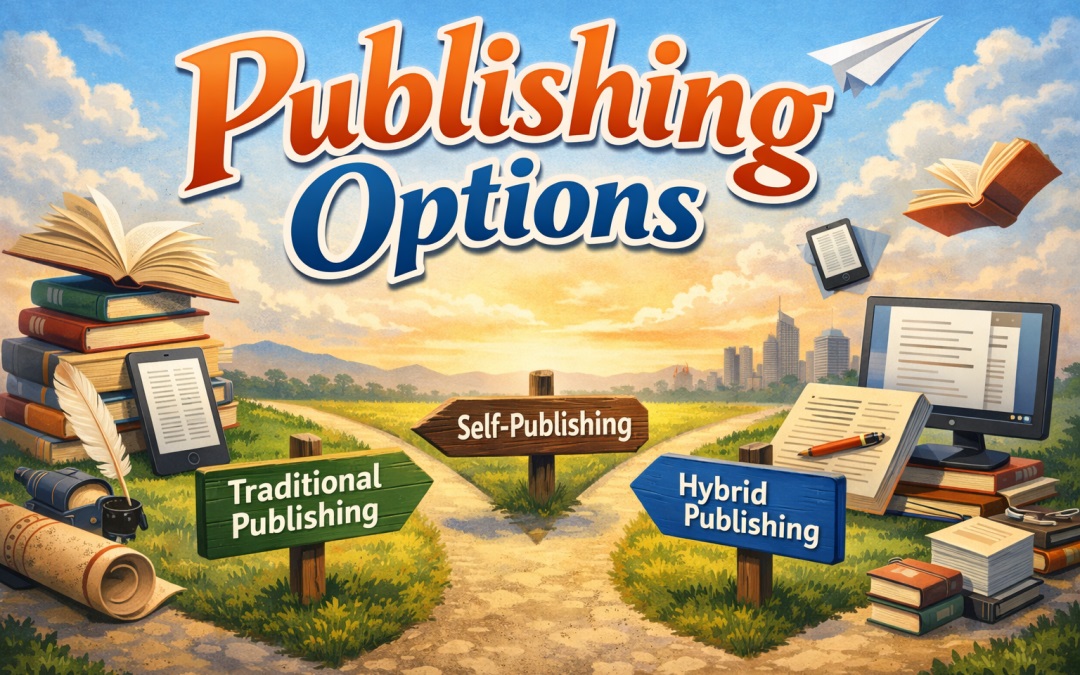
Deciding to write a book is a monumental step, but once the final sentence is typed and the manuscript is polished, authors face a daunting reality—choosing how to bring that book to the market. For decades, the publishing world operated on a binary model. You either chased a traditional publishing house or you figured out to self-publish.
Today, a third contender sits firmly in the middle of this arena: hybrid publishing.
Navigating this landscape requires a clear understanding of how traditional and hybrid models work, what they cost in time and money, and how they impact your control and financial return. An author must also determine whether the hybrid publisher is simply another name for a vanity scammer.
Traditional Publishing
Traditional publishing remains the gold standard for many writers. This is the world of the ‘Big Five’ publishing houses (Penguin Random House, HarperCollins, Simon & Schuster, Macmillan, and Hachette), as well as reputable mid-sized and independent presses.
In a traditional publishing arrangement, the publisher acts as an investor. They acquire the rights to your book, pay you an upfront advance against future royalties, and shoulder 100% of the financial burden for editing, cover design, printing, distribution, and marketing.
Advantages of Traditional Publishing
- Zero Financial Cost to the Author: You never pay a cent to a traditional publisher. If they want your book, they invest their own capital to produce and distribute it.
- The Advance: Authors receive an upfront financial advance. While debut advances can range widely, this money is yours to keep, even if the book fails to ‘earn out’ its advance.
- Prestigious Industry Validation: Traditional houses maintain deep distribution networks. Having a traditional publisher means your book is far more likely to land on physical shelves in Barnes & Noble, independent bookstores, airport shops, and public libraries.
- Professional Production Teams: You are assigned a professional developmental editor, copyeditor, proofreader, interior formatter, and cover designer, ensuring a polished, industry-standard final product.
Disadvantages of Traditional Publishing:
- Long Timeline: Traditional publishing moves at a glacial pace. It can take months just to secure an agent, more months to sell the book to an editor, and 12 to 24 months from sale to publication date.
- Loss of Control: Once you sign the contract, you sign away significant creative control. The publisher has the final say on your book title (negotiable), cover design, marketing angles, and pricing.
- Low Royalty Rates: Because the publisher assumes all financial risk, your royalty rate is relatively low—typically starting around 8% to 10% on print books, and 25% on net receipts for e-books, after your advance has been earned back.
- High Rejection Rates: Getting a traditional publishing deal often requires landing a literary agent, as many traditional publishers will not accept direct author submissions, and rejection is the baseline rule for queries. Many brilliant books never find a traditional home. Sadly, it is often who you know in the industry who knows someone else.
Hybrid Publishing: The Professional Partnership
Hybrid publishing is often misunderstood, sometimes confused with vanity presses or predatory pay-to-play operations. Often, this is actually the case, and authors must be very wary entering into a publishing agreement with a hybrid publisher. However, some hybrid publishers operate under strict industry guidelines established by organizations like the Independent Book Publishers Association (IBPA) Hybrid Criteria that provides a level of legitimacy. Writer Beware is also a good place to check a publisher. Check out these articles:
https://www.authorimprints.com/best-hybrid-publishers-criteria-evaluation/
https://leanmedia.org/8-tips-legitimate-hybrid-publisher/
In a hybrid model, the author and the publisher share the financial investment. The author pays an upfront fee to cover professional production, editing, design, and distribution, while the publisher maintains high editorial standards and pays the author significantly higher royalty rates (often 50% to 80% of net profits).
Advantages of Hybrid Publishing:
- Speed to Market: Hybrid publishers operate much faster than traditional houses. Books can often be brought to market in 6 to 9 months.
- Creative Control: Because you are investing your own money into the production, you retain a massive amount of creative control over your cover art, title, interior layout, and vision.
- Higher Royalty Returns: Since you co-funded the production, your royalty payouts are vastly superior to traditional contracts, allowing you to recoup your initial investment much faster if the book sells well.
- High Production Standards: Unlike pure self-publishing where an author might hire cheap freelancers of varying quality, a reputable hybrid publisher provides an elite, vetted team of professionals to handle your book.
Disadvantages of Hybrid Publishing:
- Upfront Financial Investment: Authors should not be fooled. Hybrid publishing is expensive. Depending on the package and publisher, costs can range anywhere from $3,000 to over $15,000, and the author takes on the financial risk if the book does not sell.
- Profit Regardless of Success: Hybrid publishers survive from fees they charge authors regardless of whether the book sells or not. This creates a conflict of interest and may reduce their incentive to market your book.
- Varying Industry Reputation: Because the barrier to entry is financial rather than purely selective, some bookstores and libraries remain prejudiced against hybrid-published books, viewing them with skepticism (though this stigma is fading as quality rises).
- The ‘Pay-to-Play’ Pitfall: The biggest danger in hybrid publishing is running into predatory vanity presses that take your money, provide subpar editing, and disappear. Authors must thoroughly research any hybrid publisher to ensure they meet IBPA standards.
- The Marketing Hype: Some hybrid publishers promise to market your book to bookstores and other outlets, but this often does not happen.
- Walking Away From the Contract: Once you enter into a contract with a hybrid publisher, it can be very difficult to cancel the agreement and get back your book rights. Always ensure the contract has a cancellation clause applicable to either party.
- Returning the Advance: Some hybrid publishers will give the author an advance. However, in case of contract cancellation, they may demand return of that advance. Always check your contract!
Comparison: Key Decision Factors
When trying to decide between traditional and hybrid publishing, evaluate your goals across these critical categories:
| Feature | Traditional Publishing | Hybrid Publishing |
| Financial Cost | $0 (Publisher pays you) | Author pays upfront production fees |
| Time to Publish | 1 to 2+ years | 6 to 9 months |
| Creative Control | Low (Publisher decides) | High (Collaborative with author) |
| Royalty Rates | 8% to 10% (Print) | 50% to 80% (Net profits) |
| Distribution | Extensive (Global retail & library) | Strong (Dependent on publisher reach) |
Reputable Hybrid Publishers
| Publisher | Services Offered | Ownership Rights |
| Atmosphere Press | Professional editing, design, marketing, distribution | Author retains ownership |
| Amplify Publishing Group | Tailored marketing and publicity services | Author retains ownership |
| Greenleaf Book Group | Comprehensive publishing services | Author retains ownership |
| She Writes Press | Focus on women authors, professional support | Author retains ownership |
| Rise Books | Diverse genres, professional editing and design | Author retains ownership |
Which Path is Right For You?
There is no single ‘correct’ choice in the modern publishing industry. There is only the choice that matches your personal resources, timeline, and career ambitions.
- Choose Traditional Publishing if: You want zero financial risk, dream of seeing your book physically stocked on major bookstore shelves across the country, value the validation of a legacy brand, and have the patience to weather years of querying and waiting.
- Choose Hybrid Publishing if: You have the capital to invest in a professional product, want to retain creative control over your work, refuse to wait two years for your book to launch, and want to capture significantly higher royalty percentages on every sale.
- Self-Publish if: You get tired waiting months for responses from traditional publishers, or you are wary of hybrid publisher hype.
Summary
The publishing landscape has evolved far beyond the old model. Whether you choose the proven, zero-cost option of traditional houses or the empowered, collaborative partnership of a reputable hybrid press, your primary obligation remains the same: writing a compelling, unforgettable story that resonates with readers.
Evaluate your budget, assess your long-term career goals, and choose the road that gets your story out into the world with integrity.
Are you leaning toward the traditional route of querying agents, or does the speed and control of hybrid publishing appeal more to your current goals? As always, writer beware!
For more articles on writing, formatting, publishing, and marketing, click on my Blog.