

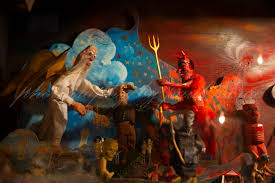
For almost two millennia, Christianity has been haunted, shaped, and disciplined by a singular concept: ‘Hell’. Yet, beneath the layers of theological gloss, pulpit theatrics, and poetic license lies a profound, deeply unsettling reality that the notion of ‘Hell’ is a gravely flawed concept.
Nevertheless, regardless of how well educated and rational a person might be, the word ‘Hell’ still manages to bring an involuntary tinge of doubt. It is a visceral reaction, a remnant of childhood Sunday school indoctrination indelibly embedded in one’s psyche and is perhaps the most evil thing perpetrated against Christian followers. The obvious question to ask: why was it done? The answer is equally obvious: to promote fear, obedience, and exercise control. Remove these elements and Church doctrine faces disintegration.
When did Christianity embrace the concept of Hell?
The Old Testament does not explicitly mention ‘Hell’ as it is commonly understood in later Christian theology. Instead, it uses the term Sheol. It is a translation of ‘grave’ or ‘the pit’, and refers to the abode of the dead and does not imply a place of eternal punishment.
The interpretation of Sheol varies among different traditions:
– Jewish Tradition: Sheol is viewed as a neutral state of death, where both the righteous and the wicked go after death.
– Christian Translations: Some modern translations of the Bible render Sheol as ‘Hell’, but many scholars argue that this translation misrepresents the concept.
The New Testament mentions ‘Hell’ through the use of specific terms that convey different aspects of the concept.
| Term | Greek Word | Occurrences | Description |
| Hell | Gehenna | 12 | Often described as a place of punishment, associated with fire and torment. |
| Hell | Hades | 9 | Generally refers to the abode of the dead; sometimes depicted as a place of torment. |
| Hell | Tartarus | 1 | Mentioned in 2 Peter 2:4, often translated as ‘Hell’, indicating a place of punishment. |
Jesus’ references to Hell:
Outer Darkness: A place of weeping and gnashing of teeth (Matthew 8:12).
Fiery Furnace: Where law-breakers are cast at the end of the age (Matthew 13:41-42).
Eternal Fire: Prepared for the devil and his angels (Matthew 25:46).
Entering the kingdom of God (Mark 9:47-48)
Suffer eternal punishment (Thessalonians 1:9)
It is interesting to note that Paul never used the word Hell in any of his writings, though he was considered the theologian of the New Testament. He spoke of God’s post-mortem purging fire in 1 Corinthians 3:11-15, but never of Hell as a place of eternal punishment. The Gospel of John does not mention Hell. The Book of Acts also never mentions Hell, except to speak of Jesus’ liberation from it.
Early Christian theologians were well versed in Zoroastrianism’s concept of torment, the ‘Duzakh’, Greek references to ‘Hades’ as a place of punishment, and the Egyptian version known as the ‘Duat’, a subterranean realm where souls journeyed after death and faced challenges and judgment. They used this knowledge to consolidate emerging doctrine and Church and authority.
In the 2nd century, Clement of Alexandria was the first to speak of God’s fire as a ‘wise fire’ which purges the sinner unto salvation. In the 3rd century, Origen spoke about restoration of all fallen beings, and Hell was corrective, not punitive or eternal. In the 4th century, Gregory of Nyssa spoke of ‘All the viciousness, that like a corrupt matter is mingled in things, shall be dissolved and consumed in the furnace of purgatorial fire.’ In the 5th century, Theodore of Mopsuestia wrote: ‘They who have chosen the good, shall, in the future world, be blessed and honored. But the wicked, who have committed evil the whole period of their lives, shall be punished till they learn, that, by continuing in sin, they only continue in misery. And when, by this means, they shall have been brought to fear God.’ In the 5th century, Saint Augustine taught that Hell is a real and physical place of punishment. He believed that individuals who do not accept Christianity face eternal torment as a consequence of their choices.
By close of the 5th century, the Church rejected the view of God’s love and replaced it with a doctrine of God as an eternal torturer, which gave rise to the Dark Ages. Since then, the Church has used the fear of Hell as a tool to enforce unquestioning obedience among followers, and directly promote control over congregations by instilling a sense of dread of eternal punishment for those who stray from Church teachings. This doctrine is still enforced today.

Breaking Down the Contradictions
The concept of Hell is a moral and psychological knot that institutional Christianity has spent two thousand years attempting to unravel. Whenever theologians step forward to explain Hell—to rationalize eternal conscious torment and reconcile it with a deity defined as love—they enter a labyrinth of contradictions.
Infinite punishment for finite crimes
When punishment for a finite transgression scales to infinity, proportionality is obliterated. This is not justice by any measure imaginable from a loving God. The Church has historically struggled to bridge this ethical chasm. Saint Thomas Aquinas, writing in the Summa Theologiae, offered a chilling justification that reveals the moral contortions required to defend the doctrine of Hell. Aquinas maintains that punishment is infinite because God is infinite, and an infraction against an infinite being incurs an infinite debt.
The Free Will Paradox
Modern apologists tell us that Hell is not a torture chamber operated by horned demons with pitchforks. It is a state of voluntary separation from God. God respects human freedom so profoundly, the argument goes, that He will not force anyone to spend eternity with Him if they do not want to. Hell, therefore, is populated exclusively by people who rejected God.
When eternal damnation is the default penalty for failing to follow Church doctrine during our fleeting earthly existence, any subsequent ‘choice’ against God ceases to be a voluntary preference. It is a psychological breakdown under duress.
Most People Ever Born Are in Hell
The Church maintains that anyone who has not embraced Jesus, including innocent children, will be condemned to eternal fire. This absurd doctrine implies that millions of people born before Jesus are condemned through no fault of their own. However, an omnipotent God created Man knowing this would happen. This cannot be explained as justice in any way, but the Church still attempts to do so by saying that God’s ways are mysterious. To cover up this inconvenience, the Church invented the concept of Limbo, something not mentioned anywhere in the Bible. Not quite heaven, but a place where souls still enjoy happiness and God’s love.
The Collapse of Divine Omnibenevolence
The most catastrophic casualty of the doctrine of Hell is the traditional attribute of divine love.
Christianity stakes its entire metaphysical claim on a central premise: God is love (1 John 4:8). Not merely that God does loving things, but that love constitutes His very essence. Love, as understood by human intuition and scriptural instruction seeks the ultimate good of the beloved. It is patient, kind, keeps no record of wrongs, and crucially, does not rejoice in destruction.
If God created beings knowing that a vast proportion of them will end up in endless agony—or if He actively sustains their existence in Hell for eternity—then love has been redefined into something unrecognizable. This is where the Church hits a wall of cognitive dissonance that it cannot explain. If God is truly omnipotent, He could redeem all creation without violating free will. To maintain Hell is to admit one of two terrifying conclusions:
– God is all-powerful, but not entirely good (He has the power to save everyone but chooses not to).
– God is entirely good, but not all-powerful (He wants to save everyone, but Hell is a cosmic force He cannot control).
Orthodox theology rejects both horns of this dilemma, insisting instead that God is both omnipotent and purely good, while simultaneously maintaining a torture chamber that has no end.
The Functional Utility of Terror
If Hell is so logically fragile, morally repugnant, and biblically flawed, why has it survived? Why do institutions cling to a doctrine that turns God into an interplanetary torturer? The answer is as old as civilization itself: social control.
Fear is a very efficient compliance mechanism. A congregation that believes its members are moments away from being cast into endless fire unless they obey Church edicts without question will submit to clerical authority. To question is to be doomed. The doctrine of Hell creates an insular ‘us versus them’ binary position that strengthens group cohesion. It provides an answer to the terrifying randomness of injustice in the world—don’t worry, the bad guys will burn later—while simultaneously keeping the flock in line through preemptive dread. It is an ecclesiastical insurance policy paid for with psychological peace of mind.
The Quiet Retreat of Modern Faith
Today, the Church finds itself trapped in an awkward silence regarding Hell.
Mainline Protestant denominations rarely mention it, preferring to focus on social justice, grace, and earthly transformation. Even within Catholicism, theologians like Hans Urs von Balthasar popularized the hopeful thesis that all might be saved.
To abandon Hell is to unravel the entire traditional narrative of Atonement. If no one is going to Hell, what precisely did Jesus save humanity from? If the penalty for sin is not eternal agony, the high-stakes drama of conversion loses its meaning.
If the Church cannot defend Hell logically, it cannot justify it morally, and it cannot discard it without rewriting its foundational premises. It remains an embarrassing heirloom in the attic of Christian theology—a relic of an ancient, fearful imagination that modern believers increasingly reject and ignore.
Until the Church adopts intellectual honesty to discard the concept entirely, Hell will stand as its greatest monument to absurdity, a doctrine that demands worship a God of love by threatening us with eternal malice of a tyrant.