

Mastering dialogue is one of the most powerful ways to elevate your fiction from a flat narrative to a vivid world. Great dialogue does not simply mirror real-life conversation. In fact, real-life conversation is often tedious, filled with endless pleasantries, repetitions, and filler words. Literary dialogue is an artifice. It must look and feel natural while simultaneously performing multiple heavy-duty narrative lifting tasks: advancing the plot, revealing character psychology, building tension, and establishing subtext.
Here is a guide to help authors master the craft of writing compelling, memorable dialogue.
Part 1: The Core Functions of Dialogue
Before putting words into your characters’ mouths, you must understand what dialogue is actually supposed to achieve. If a conversation does not accomplish at least one of the following goals, it needs to be trimmed or rewritten.
Revealing Character
Dialogue is a primary window into who a character is. A person’s word choice, rhythm, vocabulary, and cadence tells readers everything about their background, education, social status, emotional state, and core personality. A cynical, street-smart detective speaks in clipped, sharp sentences, whereas an academic historian might use precise, elevated phrasing.
Advancing the Plot
Every conversation should shift the landscape of the scene. When characters finish talking, the situation should be fundamentally different from when they started. Someone should learn a secret, make a dangerous decision, or have their perspective shattered.
Escalating Tension and Conflict
Even in a casual chat between friends, great dialogue contains micro-conflict. Characters want different things, and their desires clash. If two characters agree on everything immediately and smoothly, the scene loses its narrative momentum and leads to reader boredom.
Part 2: Differentiating Character Voices
One of the most common pitfalls for beginning writers is “author voice leakage” — the phenomenon where every character in the book sounds identical because they all speak with the author’s internal vocabulary and wit.
To create distinct voices, tailor your dialogue to individual character profiles:
- Vocabulary and Diction: Consider a character’s age, profession, and culture. Does a tech-savvy teenager use the same slang as a retired carpenter? Do they use precise technical jargon or broad colloquialisms?
- Sentence Structure and Rhythm: Some characters speak in long, elaborate, rolling sentences full of clauses and caveats. Others speak in abrupt, staccato fragments. Pay attention to tempo.
- Tics and Habits: Give characters minor verbal habits, but use them sparingly so they don’t become caricatures. A nervous character might apologize frequently; an arrogant one might interrupt others or correct their grammar.
Part 3: The Power of Subtext
Real human beings rarely say exactly what they mean. We hide our insecurities, mask our anger with humor, and lie to protect ourselves or manipulate others. This gap between what is said (text) and what is actually meant (subtext) is where the magic of fiction lives.
Example of Low Subtext (On-the-Nose)
“I am angry at you because you forgot our anniversary, John, and I feel unappreciated in this marriage.”
“I am sorry, Mary. I have been stressed at work, but I still love you.”
This exchange is flat, robotic, and emotionally sterile. It robs the reader of the joy of interpretation.
Example of High Subtext
Mary slammed the silverware drawer shut with enough force to rattle the handles. “Eat your toast before it gets cold. Not that it matters. You’ve been chewing on those spreadsheets all week anyway.”
John didn’t look up from his phone. “It’s a big quarter, Mar.”
“Right. Of course. The quarter. Silly of me to think today was special. Pass the butter.”
In the second example, the characters are arguing about toast and spreadsheets, but the reader instantly feels the weight of neglect and resentment. Subtext trusts the reader to read between the lines.
Part 4: Mechanics, Tags, and Action Beats
The technical execution of dialogue can either pull a reader smoothly through a scene or trip them up with stylistic clutter.
The Omnipresence of “Said”
Many writers fear repetition and turn to a thesaurus for exotic dialogue tags: whispered, gasped, retorted, ejaculated, pontificated, sneered.
In reality, “said” is an invisible word. The human brain skips right over it. When you inject flashy dialogue tags, you draw the reader’s attention away from the dialogue and onto the clumsy mechanics of the writing. Use “said” and “asked” for the vast majority of your dialogue tags, but do use qualifiers to add spice.
Action Beats vs. Dialogue Tags
Instead of relying on adverbs or strange tags to show emotion (“Go away,” she said angrily), use action beats to anchor the characters in physical space and display their emotions through body language.
Weak: “I never want to see you again,” he whispered tearfully.
Strong: He dropped his keys on the counter, the metal clattering against the granite. “I never want to see you again.”
Action beats also act as visual anchors, letting the reader know who is speaking without needing constant attribution.
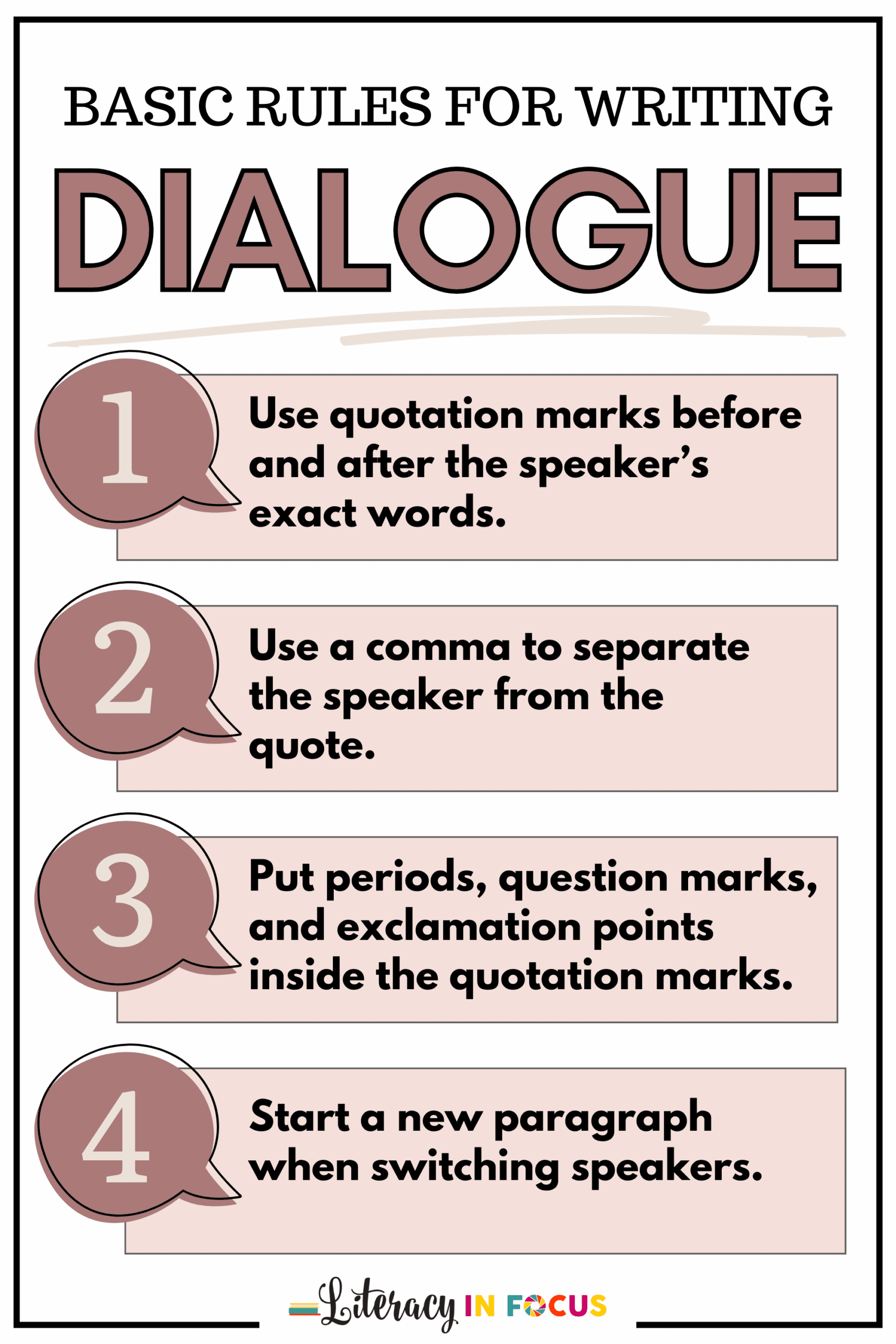
Formatting and Punctuation Rules
Clean formatting keeps your manuscript professional and readable:
- New Speaker, New Paragraph: Every time a different character speaks, start a new paragraph. This prevents a confusing wall of text.
- Punctuation inside Quotation Marks: In standard English formatting, periods and commas almost always go inside the quotation marks (“I’m leaving,” she said.).
- Splitting Dialogue with Action: If an action beat interrupts a single sentence of dialogue, punctuate it carefully: “I think,” she tapped her pen against the desk, “that we have a problem.” Notice the lowercase letter after the comma, because it is all part of one continuous sentence.
Part 5: Common Traps to Avoid
Even experienced writers occasionally fall into bad dialogue habits. Keep an eye out for these frequent mistakes during your self-editing passes.
As Exposition Dumps
Avoid the temptation to use dialogue to feed backstory to the reader by having characters explain things to each other that they both already know.
Bad: “As you know, Bob, ever since our parents died in the tragic airship accident of 2012, we’ve had to run this underground smuggling ring alone.”
Real people do not remind each other of shared foundational history unless they are intentionally arguing about it or processing trauma. If the reader needs to know a piece of backstory, weave it into the narrative or reveal it through a natural point of conflict.
Melodrama and Over-Formal Speech
In moments of high emotional drama, writers often feel compelled to make characters sound poetic or theatrical. This often backfires, making the characters sound like 19th-century stage actors rather than real people. Real grief, panic, and shock often manifest in brief, fractured statements, silence, or inappropriate humor rather than grand monologues.
Unnecessary Pleasantries
In real life, we say “Hello, how are you?”, “Fine, thanks, and you?”, and “Goodbye.” before hanging up a phone. In fiction, these social lubricants are usually dead weight. Start dialogue in media res—right in the middle of the friction—and cut the greetings and farewells unless they specifically reveal character dynamics.
Part 6: A Practical Exercise for Writing Better Dialogue
If you want to drastically improve your dialogue overnight, try this simple revision exercise on your current draft:
- Read your scene aloud . Wherever your tongue trips, the phrasing is likely unnatural. Wherever you feel bored, the subtext is missing.
- Strip away all tags. Delete every dialogue tag and action beat, leaving only the spoken words. If you can still easily tell who is speaking based purely on word choice and rhythm, you have successfully built distinct character voices. If everyone sounds like the same person, rewrite them.
- Cut the first and last lines. Often, we warm up into a conversation and drag it out past its emotional expiration point. Cutting the opening pleasantry and the trailing sign-off instantly tightens the pacing.
Conclusion
Dialogue is not just a break from narrative prose; it is a dynamic landscape where relationships shift, power dynamics change, and secrets are weaponized. By focusing on distinct character voices, anchoring your scenes with physical action, trusting your reader to decode subtext, and keeping your technical mechanics clean, you can transform ordinary conversations into unforgettable literary moments that keep readers turning pages deep into the night.
How to master dialogue? There is only one way, really, and that is to keep writing it!
For more articles on writing, formatting, publishing, and marketing, click on my Blog.