

Clearing Up Some Misconceptions
An author can self-publish an ebook and a print book for nothing! Uploading a book to Amazon KDP, Draft2Digital, and IngramSpark is free (IS may ask you to provide your own ISBN, which is an expense). Anyone can upload any file to KDP, D2D, or IS regardless how it looks internally, and these platforms will publish it. This is a major problem with self-publishing. There is a lot of very bad material on these platforms that has generated a somewhat negative image of authors who self-publish. Potential buyers feel the quality is not there. But that is another topic.
If the author is a skilled editor/proofreader, he/she can avoid the associated cost of engaging a professional to do this work, which can be substantial.
Anyone can create an JPG ebook cover using Word, Excel, Vellum, Atticus, or Adobe InDesign — if you know how to do it. The same applies to creating a print PDF cover, but this is a little more involved.
The expenses to self-publish come from associated costs for tasks an author may not wish to do himself or lacks the necessary skills to create a professional-looking ebook/print file and covers.
The Core Expense Categories
To understand what it costs to self-publish an ebook and a print book, you must understand the component parts: editing, cover design, formatting, and publishing platforms.
- Editing
No matter how many times you read your own manuscript, your brain will automatically gloss over typos, structural inconsistencies, and weak pacing. Professional editing is the single most important investment an author can make to complete a book, whether it will end up as an ebooks and/or print book. However, if an author lacks editing and proofreading experience, this step will be a necessary cost and should not be skipped.
Editing is generally split into three distinct tiers:
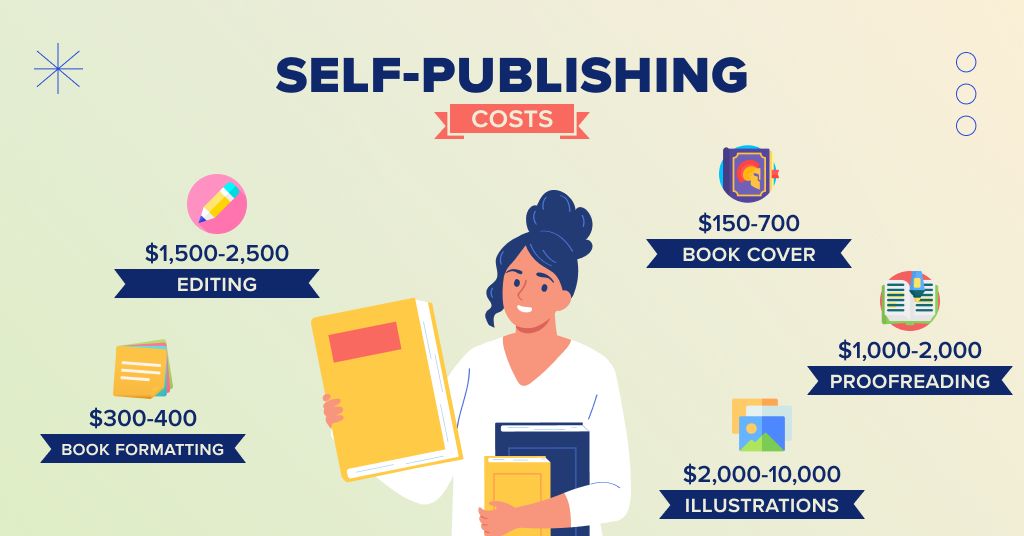
- Developmental Editing: Examines the big picture—plot holes, character arcs, pacing, and overall structure. For an 80,000-word manuscript, a developmental edit typically costs between $2,000 and $4,800.
- Copyediting: Focuses on sentence-level mechanics, grammar, consistency, flow, and syntax. This ranges from $1,200 to $2,400.
- Proofreading: The final polish to catch remaining typos, punctuation errors, and formatting ghosts right before publication. This costs between $600 and $1,200.
Many first-time authors choose to skip the pricey developmental stage if they are confident in their plot, combining a solid copyedit and proofreading pass for roughly $1,800 to $3,600. If you choose a DIY approach using beta readers and grammar software, this cost can drop to near zero, though the risk of a lower-quality final product rises sharply.
- Cover Design
Your book cover is your primary marketing tool. Readers do judge books by their covers, whether they are scrolling past a thumbnail on Amazon or picking up a physical paperback in a bookstore. The pricing here is generic, but there are many reputable cover artists who will provide excellent service for a much lower cost. It is always wise to check a cover artist’s portfolio for examples of their work before engaging one.
- Premade Covers: If you write in popular genres like romance, cozy mystery, or thriller, you can purchase a premade ebook cover for $50 to $100. The designer swaps out the text for your title, and the design is retired.
- Custom Ebook Covers: A custom-designed digital cover from a professional genre artist usually costs $80 to $400.
- Print Wraparounds: Designing a print book cover requires extending that digital front cover into a full wrap that accommodates the spine width (which varies based on page count and paper thickness) and the back cover blurb. Many designers bundle ebook and print layouts together for $120 to $300 total. Top-tier custom designers can easily charge $400 to $1,200+.
- Interior Formatting
How a book looks on the inside dictates the reading experience.
Ebook Formatting: Ebooks use reflowable text so readers can change font sizes on Kindle or Apple Books. You can format an ebook for $0 using free software like Kindle Create (be very wary using this tool) or the Reedsy Book Editor, or purchase lifetime software licenses like Atticus ($147) or Vellum ($249–$299). Hiring a freelancer to convert your file into a clean Word or EPUB file costs $100 to $250. For KDP ebooks, whose files can be submitted to other platforms such as Draft2Digital, follow KDP’s ebook formatting requirements:
https://kdp.amazon.com/en_US/help/topic/G200645680
Print Formatting: Print books require fixed layouts with precise margins, headers, page numbers, and chapter ornaments. While you can use layout tools yourself, improper print formatting leads to text swallowed by the book’s gutter (the inner binding margin). Professional print interior design costs $80 to $400, depending on whether your book is simple text or heavy with images, charts, and sidebars. If you are considering producing a hardback version of your print book that includes a dust jacket, this will entail additional cost from a cover artist who understands how to create a dust jacket. Note: At the moment, only IngramSpark offers publication of books with a dust jacket.
Read the following articles on how to format your manuscript:
https://www.stefanvucak.com/ebook-and-print-formatting/
https://www.stefanvucak.com/how-to-format-your-manuscript/
https://www.stefanvucak.com/publishing-a-hardback-book-with-a-dust-jacket/
- ISBNs and Barcodes
An International Standard Book Number (ISBN) is a unique 13-digit code required to sell your book through retail channels.
- Ebooks: Technically, major platforms like Amazon Kindle Direct Publishing (KDP) do not require an ISBN for ebooks. They assign an internal tracking number (ASIN) instead. However, if you want your ebook distributed globally across multiple retailers via aggregators, you should consider purchasing one.
- Print Books: Every physical format (paperback or hardcover) requires its own unique ISBN and a corresponding barcode for the back cover. Note: Amazon KDP, Draft2Digital, and IngramSpark will provide a free barcode. Never spend money buying one for your book.
- Free Options: Platforms like Amazon KDP and Barnes & Noble Press will provide a free ISBN for your print book. However, the catch is that the free ISBN lists that platform as the publisher of record, and you cannot use an Amazon-assigned ISBN on IngramSpark or other competing distribution sites.
- Purchased ISBNs: In the United States, ISBNs must be purchased through Bowker. A single ISBN costs $125, while a pack of 10 costs $295 ($29.50 each). Buying a block of 10 is almost always the smarter financial choice if you plan to write more than one book or publish across multiple formats. These costs vary depending from which country you purchase the ISBN(s).
- Distribution Platforms
The actual act of uploading your files to major Print-on-Demand (POD) and digital distributors is technically $0.
- Amazon KDP: Free to upload ebooks and paperbacks/hardcovers. They make their money by taking a percentage royalty cut when your book sells. You can also upload free revisions of the book.
- IngramSpark: Free to set up accounts, and free revision uploads. IngramSpark is vital for reaching brick-and-mortar bookstores and libraries, though it requires you to supply your own ISBN.
- Draft2Digital / Smashwords: Free to use for wide ebook distribution of ebooks and print versions (D2D only), taking a small percentage (usually around 10%) of your retail royalties in exchange for placing your book on Apple Books, Kobo, Barnes & Noble, and library networks. Note: Smashwords has been taken over by Draft2Digital and only lists ebooks. Upload your ebook only to D2D.
The Cost Contrast: Ebook vs Print Book
When evaluating the cost differences side-by-side, publishing an ebook is inherently cheaper because it bypasses physical manufacturing variables. Note: The stated costs imply using top-tier editors and cover designers. Usually, your self-publishing cost will be much lower. I know this from personal publishing experience.
| Expense Item | Ebook-Only Project | Print Book (Paperback/Hardcover) |
| Editing | $0 – $3,000 | $0 – $3,000 |
| Cover Design | $80 – $400 (Front only) | $80 – $400 (Full wraparound) |
| Formatting | $0 – $150 (EPUB tools) | $80 – $400 (Print layout) |
| ISBN | $0 (Optional/ASIN) | $0 (Platform-free) to $125–$295 (Bowker) |
| Sample Proofs | $0 | $10 – $50 (Ordering physical proof copies) |
| Total Estimated Cost | $80 to $3,550 | $460 to $4,145+ |
Why Print Books May Cost More
Beyond the design and layout upgrades required for a physical wrap, print books carry unique logistical costs:
- Physical Proof Copies: Before releasing a paperback to the world, you should order a physical proof copy from Amazon or IngramSpark to check the cover alignment, spine text placement, paper weight, and interior margins. Each proof costs the base printing cost plus shipping (roughly $10 to $30 per test round). A proof copy also serves one other valuable purpose; it allows you to read your book and identify bloopers the editing/proofreading steps may have missed.
- Bulk Printing: If you plan to sell books at local author events, book fairs, or to independent bookstores, Amazon KDP, IngramSpark, and Draft2Digital offer authors a discounted price to print books in bulk. Note: Of these, D2D is the most expensive option.
Three Realistic Budget Scenarios
To put these figures into perspective, most independent authors fall into one of three financial brackets based on their goals and bank accounts:
- The Ultra-Lean DIY Budget ($50 to $300)
- Strategy: You write the book, run it through free grammar checkers and AI tools, rely on free beta readers, use a premade ebook cover, format the text using free software like Kindle Create or do it yourself, and accept free platform-assigned ISBNs.
- The Result: You can successfully get both an ebook and a basic paperback onto Amazon for practically nothing. However, sales conversion rates tend to be low because the lack of professional editing and custom design often signals a ‘homemade’ product to savvy buyers. You CAN produce a great looking ebook and print book by doing your own formatting if you know how to go about it.
- The Smart Outsourcing Budget ($1,500 to $3,000)
- Strategy: This is the sweet spot for most dedicated indie authors. You invest in a professional copyedit and proofread, hire a mid-tier designer for a custom ebook and print cover wrap, buy a 10-pack of ISBNs from Bowker, purchase dedicated formatting software (like Atticus or Vellum), and reserve a small budget for launch marketing. Note: you can format your ebook and print version using Word only! There is no need to purchase formatting software.
- The Result: Your book is indistinguishable from a traditionally published title. It looks sharp, reads cleanly, and meets the quality expectations of modern bookstore patrons and digital subscribers alike.
- The Enterprise Professional Budget ($5,000 to $10,000+)
- Strategy: You hire a firm or top-tier freelancers for a comprehensive developmental edit, a line edit, and a proofread. You hire a premier, genre-specific cover designer, hire a professional book interior architect, purchase custom illustrations if writing non-fiction or fantasy, and allocate a heavy advertising budget (Amazon Ads, Facebook Ads, BookBub featured deals) for launch week. Note: This is a valid option, but the expense is prohibitive and authors can successfully self-publish for much less.
- The Result: This approach is typically used by seasoned indie professionals, non-fiction business experts building a brand, or authors scaling a rapid-release publishing business where immediate market penetration is required.
Summary of Financial Expectations
Self-publishing is a business, and every dollar spent should be viewed as an investment rather than an expense. While an ebook can be launched for the cost of an internet connection, adding a physical print component increases your upfront costs due to wrap-around design needs, interior typesetting precision, and physical proofing. Setting a realistic budget of $1,500 to $3,000 for a mixed digital and print release gives an author the highest statistical probability of producing a competitive, professional-looking book that commands consumer respect and earns back its initial investment over time … maybe.
Read my article on ebook and print formatting Here.
Read more articles about writing, editing, publishing, and marketing on my Blog.